


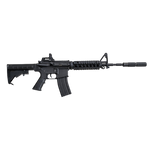



If you landed here trying to work out what the Longshot Barrett Shellblaster actually is, the honest starting point is short: we can tell you its exact name, and we can tell you it has its own product page in the GetBlaster catalog. Past that, we are not going to guess. That sounds like a thin answer, but it is the more useful one, because most confusion around product listings comes from write-ups that quietly fill the gaps with plausible detail nobody checked. This piece is about the gaps: what a product identity is, where an evidence boundary sits, and how to use both when you decide whether to keep reading, keep looking, or move on.
For a neutral catalog view, View the declared product details.
Why "what is it, exactly?" is harder than it looks
Readers arrive at a listing with a reasonable set of questions. How big is it? How hard is the build? What comes in the box? Who is it for? Those questions are easy to ask and easy to answer badly. A name suggests a shape, a shape suggests a size, a size suggests a difficulty, and four inferences later someone has published a paragraph of specifications that no source ever stated.
Build literacy, in the sense we mean it here, is not knowledge about any particular kit. It is the habit of asking, for every sentence you read about a product, where that sentence came from. Did the seller state it? Did someone measure it? Or did a writer infer it from a name and a photo? On the page all three look identical, and they are worth very different amounts when you are about to spend money.
Two terms this piece leans on
Product identity
Identity is the small set of exact details that point at one listing and nothing else: the exact current title, the handle in the page address, the image, and the destination a link resolves to. For this topic, the product title is Longshot Barrett Shellblaster, and the product has a dedicated GetBlaster product page. What identity does not do is describe the thing. It answers "which one?", never "what is it like?"
Evidence boundary
An evidence boundary is the point where a source stops speaking. A product page is the authority on its own declared details and silent on everything it does not declare. A brand's home page carries brand context and no specifications at all. Neither of those is a flaw; it is scope. The failure mode is treating silence as permission to fill in, and naming a boundary out loud beats writing around it.
What we checked before writing this
Two sources sit behind this article, and both belong to GetBlaster. The first is the product page for this listing, which the GetBlaster editorial team treated strictly as the place where the exact current title, handle, image, and destination are declared. We used it for identity and for nothing else. The second is the GetBlaster home page, read as brand context only; it is not a specification source, and we did not mine it for one.
It is worth being precise about what "checked" means, because that word does a lot of unearned work in product writing. We confirmed which statements each of those two sources actually supports. We did not test a physical item, measure anything, time a build, or evaluate an outcome. We also worked from the position that product details need confirming against the current page before anyone relies on them, since a listing is a living page that can change after an article is written.
That is what produced the editorial shape you are reading: name the product exactly, say where the declared details live, and decline to restate specifications in an article that cannot keep pace with the page they came from.
Where this evidence runs out
Plainly: performance, range, age suitability, piece count, materials, build difficulty, assembly time, durability, and safety outcomes all sit outside what these sources establish. None of them is supported here, so none of them appears above. If you came for a specification table, this article does not have one, and any article that hands you one without saying where each number came from deserves a second look.
Read that as scope, not as a verdict. "We cannot support this claim" is a statement about our evidence; it is not a quiet way of saying the opposite. Nothing here implies the product performs poorly, or lacks any particular quality, or is unsuitable for anyone.
There is a second, subtler limit worth naming. A product page is a declaration: a seller's statement about their own listing, in their own words, at one moment. That is a normal thing for a listing to be, and it is not the same as independent verification of a physical object or a tested outcome. Both of our sources are brand-owned. There is no third-party evaluation in the stack, no test data, and no long-term observation. Treating a declaration as proof is the exact move that turns a careful article into an inaccurate one.
A checklist you can run in a minute
None of this requires expertise. It requires about a minute and a little stubbornness.
- Confirm the exact title you meant to open: Longshot Barrett Shellblaster.
- Read the declared details on the product page itself rather than a summary of it.
- Write down the one question that would change your decision, then see whether the page answers it.
- Label each claim as declared, measured, or inferred, and discount the third.
- Re-check the details at the moment you decide, because listings change after articles are published.
Reading a declaration without over-reading it
A declaration answers one question well: what does the seller say this listing is? Read it with its scope attached, meaning this listing, these words, this moment. The strong reading is that the page states something. The weak reading is everything stacked on top of that: implications, comparisons, and assumptions about what a name or an image must mean. Title, handle, image, and destination tell you which listing you are on; they do not become a specification sheet by being read closely.
Where the product page fits
The declared details for this listing live on its own page in the GetBlaster catalog, and that page is where you can view them. We are not going to characterise what you will find there, or tell you it fits your shelf, your household, or your build plans. That judgment is yours to make against the current details.
Questions worth asking before anyone builds
This article makes no age, safety, or suitability claim, because the sources behind it do not support one. What it can offer is the shape of the decision. Who is this for, and who in the household is making the call? Have you read the current declared details yourself, rather than someone's description of them? Is there a question that matters to you which the page does not answer, and is that gap enough to stop you? Supervision and storage decisions belong to the adults involved, and they are better made against current details than against a write-up.
When you want to review the catalog context, Explore the product-page declarations.
Sources
- Longshot Barrett Shellblaster product page (GetBlaster) — used for product identity only: exact current title, handle, image, and destination.
- GetBlaster home — brand context only; no specifications drawn from it.
Related reading from GETBLASTER

Review the product details
Longshot Barrett Shellblaster
Review the declared product details and build context on the product page before deciding what to explore next.