



Most kids meet a real gun before anyone teaches them what to do
A household writer on why the first lesson in America is often unsupervised — and why a talk at the kitchen table is not the same as a practiced response.
Parents searching how to talk to kids about guns usually get a kitchen-table script. This desk looks at the house that is not yours — the playdate, the sleepover, the first unsupervised contact — and why a sentence on the fridge is not a practiced response.

Marcus, 41, Dayton. He thought the news was about other houses.
Marcus told me he kept the TV on mute until the crawl hit a number he could not shake. A child. A house. A firearm that was never supposed to be in reach.
He looked at the sippy cup on his coffee table and did the thing a lot of dads do. He told himself, not in my house.
Two weeks later his nine-year-old came home from a playdate talking about “the heavy one in the closet.”
There was no shot. There was no cop at the door. There was a kid who had already met a real gun — in someone else’s house — before anyone had walked him through what to do with his hands.
Four questions most parents skip
If you have a school-age kid, sit with these. Do they sound familiar?
- Have you asked the other parent, before the playdate, whether there is a firearm in that house?
- If yes — is it locked, unloaded, and is the ammunition locked somewhere else?
- Does your child know what to do if they see a gun and no adult is in the room?
- If you gave them a one-time talk last year, would they still leave it alone today?
Marcus had asked none of them. He had a lockbox. He had a talk planned “when they’re older.” His kid still had a first contact. It just was not in Marcus’s closet.

Someone else’s house. Someone else’s rules. Your kid still walks in.
The first time is usually unsupervised
American kids do not wait for a permission slip. They find what is interesting. A closet. A nightstand. A backpack after hunting season. A friend’s dad who “knows how to handle it.”
CDC figures used by pediatric groups put a firearm in about 1 in 3 U.S. homes with children. That is not a scare line invented for this page. It is why a locked house next door does not travel with your child to a birthday party.
If the first time they see a real gun is also the first time they have to decide what to do, you have already given the lesson to the room — not to the parent.

A lock only works when it is closed. Curiosity does not wait for that.
A talk is a sentence. A response is a habit.
Most of us were raised on “don’t touch that.” We say it once. We point at a fridge note. We assume the words stuck.
They don’t. Not when the thing in the closet looks heavy and important and a little bit like every movie they have already watched.

The lecture is happening. The kid is somewhere else.
Firearm education at a young age is not about making a child comfortable with a real firearm. It is about making the wrong first move expensive to forget before that first unsupervised contact happens.
What actually sticks
Eddie Eagle’s four responses are simple on purpose: Stop. Don’t touch. Leave. Tell a grown-up.
Himle, Miltenberger and colleagues (Journal of Applied Behavior Analysis, 2004) ran those responses as rehearsal with feedback — not as a poster on the wall. Kids who only heard the rules could often say them. Kids who practiced the moves were the ones who did them when an unsupervised “found gun” setup appeared.
The gap is not information. The gap is reps.
Two steps that turn a rule into a reflex
You are not trying to raise a shooter. You are trying to raise a kid who has already used their hands on the boring, correct sequence — so the first real gun they meet is not also their first time making a choice.

Adult-led loading. Toy casings. This is practice, not a range trip.

The lesson has to be interesting enough to repeat. Shell ejection is why kids ask to run it again.
The tool parents are using
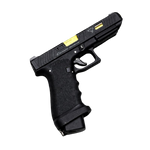
The practice pistol in those photos is the Raven — a firearm education tool built in toy form. It loads plastic darts into reusable toy casings, fires, and ejects the casings. That motion is the point. Kids will do the reps because it feels like the movies. Parents stay in the room because it is still a toy.
Brick is the color that sells out first. Soft-tip darts. Adult supervision. It does not replace a lockbox, and it does not replace a real class. It fills the hole between “I told them once” and “they already found one.”
★★★★★ 4.76/5 · 200 Judge.me reviews
What parents actually say

Pedro O. · ★★★★★
Love it. My sons is enjoying learning how to use it and doing target practice.

Ryan Q. · ★★★★★
It’s awesome so much fun to play with

Frank H. · ★★★★★
Surprisingly really fun
Kate O. — “Its an awesome tool to be able to teach our kids about gun safety, safely.”
The first ten reps feel awkward. That is the point.
Kids giggle. They point it the wrong way once. You stop them. You reset. You do it again. The awkwardness is cheaper in the backyard than in a closet that is not yours.
If they are bored after day one, you are doing it right. Habits are supposed to get boring.

Get the firearm education tool
From $38 today $127
Bundles save up to 80% + free shipping
- Shell-ejecting practice pistol in toy form
- Soft-tip darts and reusable toy casings
- 90-day money-back
- Order today — ships tomorrow
90-day money-back guarantee · Buy 1 save 70% / 2 save 75% / 3+ save 80%
If you wait until they are “old enough,” the first contact may already have happened without you.
P.S. About 1 in 3 American homes with children have a firearm. Your lock does not go to the sleepover. The four responses can.
Sources named in this article: CDC household-firearm figures used by pediatric groups; Himle, Miltenberger et al., Journal of Applied Behavior Analysis, 2004; Eddie Eagle Stop / Don’t Touch / Leave / Tell. Raven is a supervised firearm-education tool built in toy form. It does not replace secure storage, adult supervision, or formal instruction.