


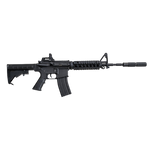
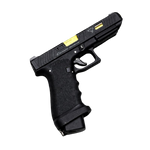


If a child finds a gun, the safest simple response is: stop, do not touch it, leave the area, and tell an adult immediately.[1] That rule applies even when the object looks like a toy.[1]
This guide is for parents and caregivers preparing for playdates or other homes where children may spend time. It explains the response to teach, the storage questions adults should ask, and what the available studies can—and cannot—tell us. It is not a substitute for local law, a qualified instructor, emergency services, or a household storage plan.
The four-step response
- Stop. Pause.[1] Do not pick the object up, move it, or ask another child to inspect it.[1] A child does not need to decide whether it is real before stepping away.[1]
- Do not touch it. Hands stay off.[1] This includes an object that looks like a toy.[1]
- Leave the area. Move away and take other children with you if that can be done without going back toward the object.[1] Do not stay nearby to watch, photograph, or prove what was found.[1]
- Tell an adult. Tell a trusted adult right away. The adult—not the child—should handle the next step and contact emergency help when there is an immediate danger.[1]
Keep the sentence short enough to remember: stop, do not touch, leave, tell an adult.[1]
The adult safety baseline: storage comes first
Teaching the four steps does not make an unsecured firearm safe.[2][3] The Centers for Disease Control and Prevention says that putting a firearm out of sight or out of reach is not secure storage; it recommends secure storage to prevent access by children and other unauthorized people.[2]
For a firearm kept in a home, the CDC and the American Academy of Pediatrics describe a safer baseline as:
- the firearm is unloaded.[2][3]
- the firearm is locked in a secure location that children cannot access.[2][3]
- ammunition is locked separately from the firearm.[2][3]
The Bureau of Alcohol, Tobacco, Firearms and Explosives likewise says to keep ammunition locked away from firearms and to use child-safety locks or another suitable locking method when children are in the home.[4] Follow the product instructions for any lock or safe and all applicable local laws.
A parent playdate checklist
- Are there firearms in the home?[3]
- Is every firearm stored unloaded and locked?[2][3]
- Is ammunition locked separately from the firearms?[2][3]
- Can children access the keys, code, or other way into the storage?[3]
- Who is the supervising adult, and what should my child do if they see an unfamiliar object?[1][3]
The AAP advises parents to ask about guns in homes where children play and to reconsider the visit when a firearm is unsecured.[3] Asking is a safety check, not an accusation. If the answer is unclear or the arrangement does not feel safe, host the children at your home or choose another plan.
Adult supervision matters, but it is not a replacement for locked, unloaded, separate storage.[7] A responsible plan uses both an environment adults have made safer and a response a child can remember.[1][7]
What the named studies actually show
Jackman et al.: prior instruction did not equal safe behavior
In a study of boys aged 8–12, Jackman and colleagues reported that more than 90% of the boys who handled a found handgun or pulled its trigger said they had received some prior gun-safety instruction.[5] The study is a warning against treating a child’s ability to repeat a rule as proof that the rule will guide behavior in an unexpected moment.[5]
Evidence limit: this was a specific study population and situation, based in part on what participants reported.[5] It does not prove that instruction caused unsafe behavior, that one result applies to every child or family, or that a lesson prevents injury.[5] It did not test Raven.[5]
Himle and Miltenberger: rehearsal is a different test from recall
The Himle/Miltenberger study compared child gun-safety teaching approaches.[6] Children could learn to say the safety message, while behavioral rehearsal and feedback improved performance in supervised role-play.[6]
Evidence limit: supervised role-play is not the same as handling a real firearm in an unsupervised setting.[6] The study did not test Raven, did not establish that a toy transfers skills to real firearms, and does not justify a guarantee about what any child will do.[6]
The CDC’s later review of 1,262 unintentional firearm-injury deaths among children aged 0–17 in NVDRS data from 2003–2021 found that playing with or showing the firearm was the most common reported precipitating circumstance.[7] The categories describe fatal unintentional cases, can overlap, and do not predict an individual family’s behavior.[7] That is why storage and adult responsibility stay ahead of any educational exercise.[7]
A small plan for the next playdate
- Before the visit: ask the storage questions and decide where the children will play.[3]
- At home: say the four-step response in plain language and let the child repeat it.[1]
- During the visit: keep the supervising adult and exit plan clear; do not ask children to search for firearms.[1][3]
- If a child reports a gun: praise the report, keep everyone away, and let an adult take over.[1]
- Afterward: answer questions without turning the event into a dare, test, or game.
This plan is deliberately ordinary. The goal is not to frighten a child or create confidence that cannot be earned. It is to make the safe response easy to remember and pair it with an environment adults have made safer.
Frequently asked questions
What if the object looks like a toy?
Do not touch it. Leave the area and tell an adult. A child should not be asked to identify it first.[1]
Is one safety talk enough?
No one can promise that a single talk, class, article, or quiz will control behavior in every situation. The Jackman and Himle/Miltenberger evidence above shows why recall, supervised practice, and real-world behavior must not be treated as the same outcome.[5][6]
Should I ask about firearms before a playdate if I do not own one?
Yes. The AAP specifically advises parents to ask about guns in homes where children play. Ask about storage, not only presence.[3]
Does “hidden” mean “safe”?
No. The CDC says out-of-sight or out-of-reach storage alone is not secure storage.[2]
Should this guide teach a child to handle a real firearm?
No. This guide teaches a leave-and-tell response. Real-firearm handling, if appropriate under local law and family circumstances, belongs with qualified adult supervision and formal instruction; this page is not a handling manual.
Editorial review: GETBLASTER Editorial Team checked this guide against the linked official safety sources on August 27, 2026. The Raven product note is separate from the safety-source summary.
Sources
- Project ChildSafe — A Guide to Responsible Gun Ownership
- CDC — Preventing Firearm Injury and Death
- HealthyChildren.org — Guns in the Home: How to Keep Kids Safe
- ATF — Learn About Firearms Safety and Security
- PubMed — Seeing is believing
- PubMed — Training skills to prevent gun play
- CDC MMWR — Unintentional Firearm Injury Deaths, 2003–2021