The first rule is simple. The research-backed part most families miss is turning that sentence into calm, repeatable behavior.
Michael Reed ✓
Family Safety Contributor · Updated August 19, 2026
The question parents ask at night is usually the right one: will the rule still be there in the moment?
Most parents begin with the right sentence: if you ever see a real firearm, stop, do not touch it, leave, and tell an adult.
That message matters. Secure storage matters even more.
But two landmark studies found an uncomfortable gap between what children could say and what they did in a realistic situation. In the 2001 Emory study, 64 boys ages 8–12 entered a room where a real, disabled handgun had been hidden.
72%of groups found it
76%of finding groups handled it
48%of finding groups pulled the trigger
90%+who handled or triggered it had prior safety instruction
The lesson is not “talk less.” It is talk, model, rehearse, give feedback—and keep real firearms inaccessible.
“Don’t touch” is the first move. Leaving and telling complete the response.
The child-safety response is short on purpose:
1STOP
2DON’T TOUCH
3LEAVE
4TELL AN ADULT
The words give a child a clean first response. They also give parents one message to repeat instead of ten competing warnings.
Keep the first lesson simple enough to remember—and specific enough to act on.
The official Eddie Eagle program uses the same four-step response. See the program.
LESSON 2
Turn the sentence into a routine with modeling, rehearsal, and feedback.
In a 2004 Pediatrics study, children in two programs learned to repeat the safety message. The difference appeared in what happened next.
Behavioral skills training—instruction, modeling, rehearsal, and feedback—improved performance during supervised role-play. The improvement did not reliably carry into a later in-situ assessment, which is exactly why no parent should treat one lesson as permanent protection.
A simple home rehearsal can be calm: the adult models the response, the child repeats it, then the adult changes the room or starting point and gives feedback.
Practice helps. Storage and supervision remain the protection layer.
Secure storage is not optional. Education never replaces it.
For any real firearm in the home, the American Academy of Pediatrics’ parent guidance is direct: keep it locked and unloaded, keep ammunition locked separately, and keep keys or combinations inaccessible to children.
Real firearm locked and unloaded when not in use
Ammunition locked separately
Keys and combinations unavailable to children
The same storage question asked before playdates
A child’s behavior is never the lock. The lock is the lock.
During supervised target play, repeat the same house rules every time.
The honest use case is simple: a parent-led target game creates another place to repeat careful habits during play—without handing a child a real firearm.
Protective glasses on before play begins
Clear target area and safe direction chosen by the adult
Finger outside the trigger guard until the adult starts the turn
Stop signal ends the turn immediately
Unload, check clear, and store the toy after play
The value is not one dramatic lecture. It is the same calm routine, repeated.
THE PRODUCT BRIDGE
Why parents use a shell-ejecting toy blaster for the routine
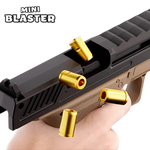
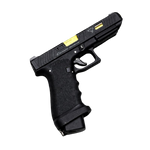
Many toy blasters skip straight to “pull the trigger.” Raven adds a deliberate sequence: plastic dart into a reusable casing, casings into the magazine, rack the slide, fire, watch the casing eject, then check the blaster before storage.
That makes the target-play routine slower, more visible, and easier for a parent to coach—while remaining a toy that fires plastic darts.
Real Raven footage: load, rack, aim, and reset—shown with the exact Brick product.
LESSON 5
Choose the toy your child will actually ask to practice with again.
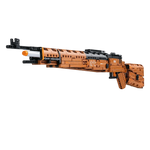
A routine only works if the child wants to repeat it. Raven combines a colorful buildable shell with a working magazine, slide, reusable casings, and five color choices.
Real customer setups from the current Raven review gallery.
4.76
★★★★★
200 Raven reviews on the current product page
“Bought this for my son to teach him gun safety in a fun, responsible way. He loved it, and it made learning the rules together easy and engaging. Perfect gift.”
Parents keep filming the mechanism because it is the part kids notice first.REAL RAVEN CREATOR FOOTAGE · EXACT BRICK PRODUCT
The product is the gift. The repeatable parent-child routine is the reason it lasts.
MEET THE RAVEN SHELLBLASTER
Make supervised target play the routine they request.
From $38 today $127
Buy 1: 70% off · Buy 2: 75% off · Buy 3+: 80% off + free shipping
Does toy-blaster practice replace secure firearm storage?
No. Real firearms still need to be locked and unloaded, with ammunition locked separately and keys or combinations inaccessible to children.
What does the Raven fire?
The Raven is a toy blaster that fires plastic darts loaded into reusable toy casings.
What comes with the current Raven kit?
The current PDP lists the Raven, 20 plastic darts, 6 reusable shells, a display stand, brick set, sticker pack, and instruction manual. Color and live offer details are shown on the product page.
Research cited: Jackman et al. (2001), Himle et al. (2004), AAP HealthyChildren, NSSF Project ChildSafe, and Eddie Eagle.