
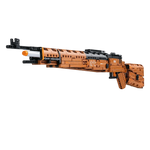

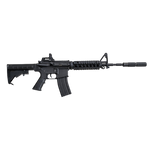
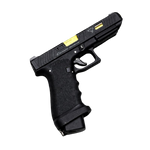


When a child sees something that could be a gun, the useful response is short: stop, leave it alone, move away, and tell an adult. Parents can teach those words calmly and practice them in a simple conversation. Adult storage and supervision remain separate responsibilities; a child’s practiced answer does not replace them.
For a neutral catalog view, View the declared product details.
Use one rule when an object is uncertain
Project ChildSafe tells children not to look for guns. If a child finds one, its guidance says to stop, leave it alone, leave the area, and tell an adult right away. It also warns that a real gun may look like a toy, so a child should not try to decide whether an unfamiliar object is real before following the same response. The rule is about getting away and asking an adult for help, not inspecting an object.
A parent can introduce the rule in plain words before a child needs it. Keep the message steady: “Don’t touch it. Leave the area. Tell an adult.” If a child asks whether a toy-looking object is different, repeat that the child does not need to identify it. The next step is still to leave it alone and find an adult. This keeps the response clear when the child feels unsure.
Talk about the rule without asking a child to search a home, handle a firearm, or use a real object as a practice prop. A short verbal example is enough for a parent to hear which words the child remembers. The lesson stays focused on recognizing an uncertain situation and getting adult help, not on learning how a firearm works.
Repeat a calm four-part routine
Give the child the same short sequence each time. The purpose is to make the words familiar in a quiet setting, with an adult present to explain and correct them. A parent can use a made-up sentence such as, “You notice something that might be a gun at a friend’s home. What do you do?” The child can answer without looking for or touching anything.
- Explain. Say the rule in simple language: stop, don’t touch, leave the area, and tell an adult right away. Explain that the child should not decide for themselves whether a toy-looking object is safe.
- Model. Show what the response sounds like by saying the words yourself. Keep the example verbal. The point is to model leaving an uncertain situation and getting help, not to demonstrate handling, checking, or moving an object.
- Rehearse. Ask one brief, made-up question and let the child say the response. Use familiar settings, such as a home or a visit with friends, without hiding objects or asking the child to find one.
- Give feedback. Thank the child for the parts they remembered. If a step is missing, say the full response again and invite one calm retry. Avoid turning the practice into a test of courage or a guessing game about whether an object is real.
The order matters for the conversation: the child leaves the object alone, moves away, and gets an adult. Parents can keep the same words while the child grows more comfortable saying them. The routine is a practice aid for a parent-led discussion, not a promise about how a child will respond in every situation.
Keep storage and supervision with adults
Children should not carry the job of making a home safe. The HealthyChildren.org guide discusses secure storage that children cannot access and raises questions parents can ask before a playdate. Those are adult decisions. A parent can ask the other caregiver whether firearms are present, how children are supervised, and what the household plan is if a child notices an unfamiliar object.
Project ChildSafe also directs adults to keep firearms secured and inaccessible to children. A child’s verbal practice does not replace adult storage choices, supervision, or formal instruction. Keep those subjects separate: the child learns to leave an uncertain object alone and tell an adult; adults remain responsible for the environment and the decisions made about storage and supervision.
For a visit, a parent can make the questions concrete and calm: “Will an adult be with the kids? Are there firearms in the home? What should my child do if they see something they are not sure about?” The source material supports asking about playdate conditions; the answers help parents decide what is appropriate for their family. A child should never be sent to search for an answer or verify an object.
What the cited research can describe
The PubMed record by Jackman and colleagues is relevant to observed behavior and limits of prior instruction. A second record by Himle and Miltenberger and colleagues distinguishes verbal recall, rehearsal, supervised role-play, and an in-situ limit. These are different kinds of evidence; they should not be collapsed into one claim that a child will act safely after hearing a rule.
A calm parent-led conversation can combine instruction, modeling, rehearsal, and feedback. The cited materials let readers check the safety guidance and the research records. They do not establish a measured effect, a success rate, or that any single script works for every child or setting.
Check the routine with a few questions
After a short practice, a parent can ask:
- Can my child say not to touch an unfamiliar object?
- Can my child say to leave the area and tell an adult?
- Does my child understand that a toy-like appearance does not make an uncertain object theirs to inspect?
- Have I kept practice verbal, without asking the child to search for or handle a real object?
- Have I spoken with the other caregiver about supervision and the home before a visit?
If an answer is incomplete, return to the short rule and repeat it calmly. Parents can keep the conversation open without adding frightening details or asking a child to make an adult storage decision. The point is to keep the child’s part simple and leave the larger safety responsibilities with adults.
A separate note about Raven
GETBLASTER describes Raven Shellblaster as a supervised firearm-education tool built in toy form. That product description is separate from guidance about real-firearm storage, adult supervision, or formal instruction. It does not promise that a child will transfer a practiced response to another setting or prevent an injury.
When you want to review the catalog context, Explore the product-page declarations.
Sources
The safety guidance and research records referenced above are available here:
- Project ChildSafe — A Guide to Responsible Gun Ownership
- HealthyChildren.org — Guns in the Home: How to Keep Kids Safe
- PubMed — Jackman et al., PMID 11389238
- PubMed — Himle and Miltenberger et al., PMID 14702451
Related reading from GETBLASTER
- Firearm Storage With Children at Home: A Practical Parent Guide
- Gun Safety Before Range Day: A Parent Checklist

Review the product details
Raven Shellblaster
Review the declared product details and build context on the product page before deciding what to explore next.