
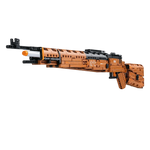




A compatibility line is usually the shortest sentence on a product page and the one people reread the most. It quietly tells you what a set is meant to sit alongside, and where that promise stops. The GETBLASTER editorial team writes those lines narrowly on purpose, and here is how we decide what a compatibility sentence for the Brick Set is allowed to say.
For a neutral catalog view, View the declared product details.
Why one short sentence carries so much weight
Most people do not read a product page from top to bottom. They scan for the two or three lines that answer the question they arrived with, and a compatibility statement is almost always one of them. That makes it load-bearing. When it is written loosely, readers finish it in their own heads, and the version they invent is nearly always more generous than the version anyone could stand behind.
That is the failure mode we design against. A hypothetical line such as "works with most bricks" — the kind of phrasing we do not use — reads as reassurance while handing the reader an open-ended promise with no edges. Narrow phrasing is less fun to write and far more useful to read: it tells you what is covered and, by omission, what is not.
What exact compatibility wording actually means
Exact compatibility wording is a small discipline with one rule behind it: the sentence that ships is the sentence that was proven, and nothing adjacent gets quietly promoted into it. It is treated as a quotation, not a draft.
For the Brick Set, the compatibility wording we carry is restricted to the proven Shellblaster Brick Edition statement. The edition name is doing as much work as the verb. Shellblaster Brick Edition names one specific edition, and the statement travels with that name attached to it. Shortening the name, generalising it to a family, or shifting it into the plural would each produce a sentence broader than the one on record — a new claim wearing an old claim's clothes.
What is actually on the record
Two sources sit behind this article, and it is worth being plain about what each one establishes. The first is the Brick Set product listing in the GetBlaster catalogue. It establishes product identity: the product title is Brick Set, and the product has its own dedicated GetBlaster product page. The editorial note attached to that listing is equally specific — it tells our team to take the current title, handle, image, and destination from the listing itself rather than from memory.
The second source is GetBlaster home, and its role is deliberately limited: brand context only. It tells a reader what kind of catalogue the Brick Set sits in. It does not establish compatibility with anything, and it does not establish any affiliation with any other manufacturer or brand. Treating a homepage as evidence of either would be reading a great deal into a page that was never making that argument.
Put together, the record supports three things: the product's title, its own product page, and a compatibility statement held to the exact proven Shellblaster Brick Edition wording. Everything in this article that touches the product traces back to one of those three.
Where the record stops
A declaration is a declaration. A product page and its accompanying notes describe what is stated about a product; they are not independent proof of how the thing is built, what it is made from, how it holds up over time, or how it behaves in your hands. Our editorial team treats those declarations as the beginning of a record rather than the end of an argument, which is why this article describes wording rather than promising outcomes.
The limits are specific enough to name. Nothing in this material is a comparative test, a measurement, or a third-party assessment. There is no data here about fit tolerance, strength, finish, contents, or how the set behaves alongside anything other than the one named edition. There is nothing that would let us tell you the wording applies more broadly than it does, and nothing that would let us characterise any relationship between GetBlaster and any other company.
Some reasonable questions therefore go unanswered here. We would rather leave a gap visible than fill it with a sentence that sounds authoritative and is not sourced.
A reading checklist for any compatibility line
Whoever wrote the line, these questions travel well:
- Does the sentence name something specific, or does it gesture at a category?
- Is the named thing an exact edition name, or a shortened version of one?
- Does the wording claim a range, a family, or a plural where the proof may only cover one item?
- Does the page tell you where the statement came from, or ask you to take it on trust?
- Are you filling in any part of the sentence yourself? If so, that part is yours, not theirs.
How to read the declaration itself
A declaration tells you what a seller is willing to put its name to. That is genuinely useful information — it is a commitment, and it can be checked against the page it came from. It is not the same as a demonstration. When you read the compatibility statement for the Brick Set, read it as scoped to exactly what it names: one edition, stated once, without a broader family implied around it.
Where the Brick Set listing fits
The Brick Set has its own page in the GetBlaster catalogue, and that page is where the declared details live: the current title, the current image, and the current product information as published. If you want to see what is declared rather than what an article summarises, that is where it is kept. Whether it belongs in your collection is your call, not ours.
Questions worth asking before anything joins the shelf
We have no safety specifics on record here, so this section is questions rather than assurances. Who will be handling the set, and does that suggest adult supervision during play? Where will it live between sessions, and are you comfortable with that spot? And on compatibility specifically: does the wording cover the exact thing you plan to pair it with, or are you extending it a step further than it goes? If it is the second, treat the extension as untested.
When you want to review the catalog context, Explore the product-page declarations.
Sources
- Brick Set product page — the listing in the GetBlaster catalogue, used for the product title, the dedicated product page, and the compatibility wording restriction described above.
- GetBlaster home — brand context only.
This is an editorial explainer from the GETBLASTER team, written to the record above and no further.
Related reading from GETBLASTER
- Firearm Storage With Children at Home: A Practical Parent Guide
- Gun Safety Before Range Day: A Parent Checklist

Review the product details
Brick Set
Review the declared product details and build context on the product page before deciding what to explore next.